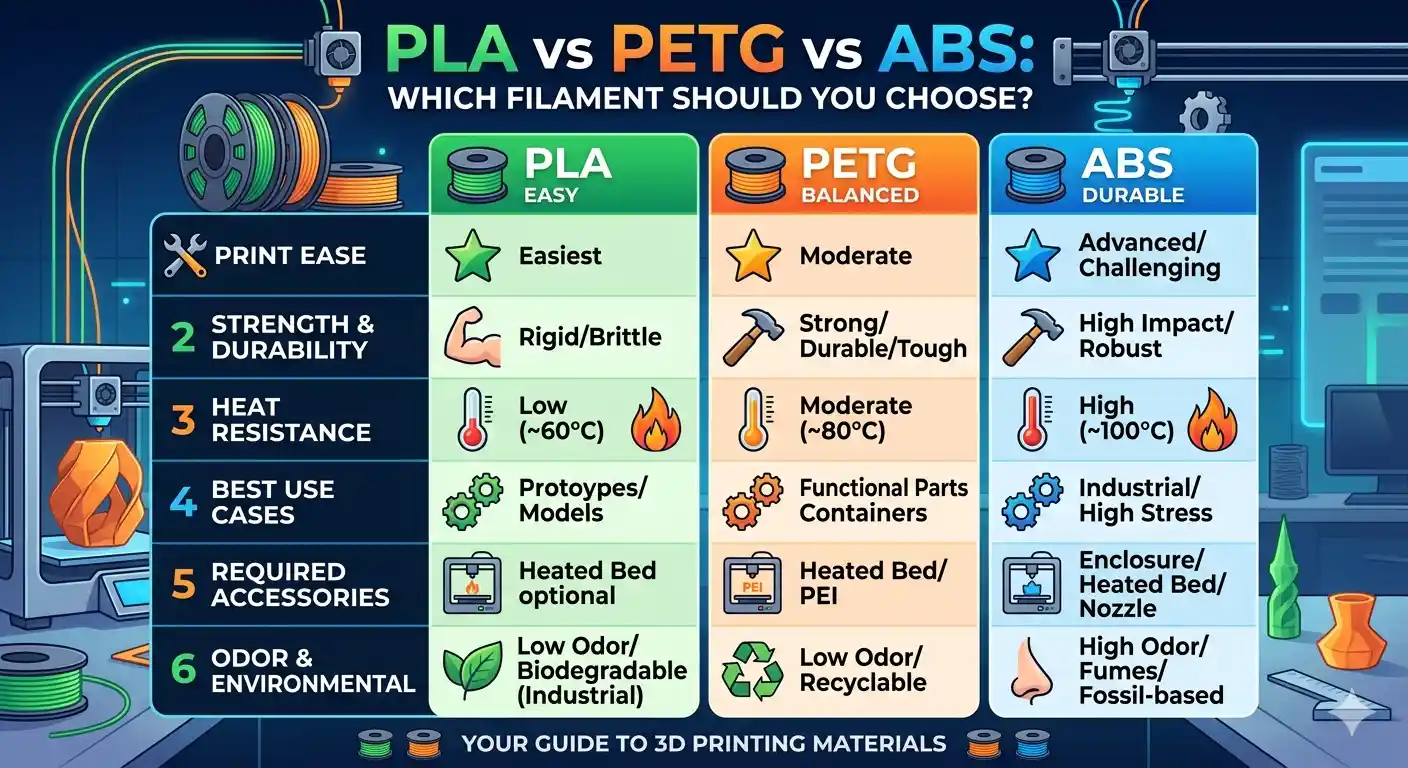
If you've ever tried to place a 3D printing order and got stuck at the material selection screen, you're not alone. It's the most common question we get on WhatsApp every single day. So here's the honest, no-jargon answer.
PLA — Start Here If You're Unsure
PLA is the most widely used 3D printing material in the world, and for good reason. It's affordable, produces a great surface finish, prints reliably, and is biodegradable. If you're a student making a college project, an architect building a presentation model, or a creator making props for your YouTube setup — PLA is your answer. At Flux 3D, PLA+ prints start at ₹8 per gram, making it the most budget-friendly option we offer.
The only real weakness of PLA is heat. Anything left inside a car on a sunny Mumbai afternoon or placed near a heat source can warp. So if your part needs to survive high temperatures, read on.
PETG — The Sweet Spot Between Easy and Strong
PETG is where things get interesting. It combines the ease of printing that PLA offers with significantly better strength, heat resistance, and flexibility. It's also food-safe and moisture-resistant, which makes it ideal for containers, kitchen accessories, and anything that touches water.
If you're printing a functional bracket, an enclosure for electronics, a replacement part for a machine, or anything that will be under real mechanical stress — PETG is almost always the right call. It costs just ₹9 per gram at Flux 3D, barely more than PLA, but the performance difference is enormous.
ABS — When You Need Industrial Toughness
ABS is what LEGO bricks are made from. It's tough, impact-resistant, and handles heat much better than both PLA and PETG. If you're printing automotive components, electrical enclosures, or anything that needs to survive rough handling, ABS is your material.
The trade-off is that ABS is harder to print and produces slightly more visible layer lines. It's also not biodegradable. But for industrial and engineering applications, these trade-offs are completely worth it. ABS prints at Flux 3D start at ₹10 per gram.
Quick Decision Guide
Use PLA for display models, student projects, gifts, prototypes, and anything decorative. Use PETG for functional parts, containers, brackets, and anything that needs strength or light flexibility. Use ABS for industrial parts, automotive components, electrical enclosures, and high-heat environments.
Flux 3D Team