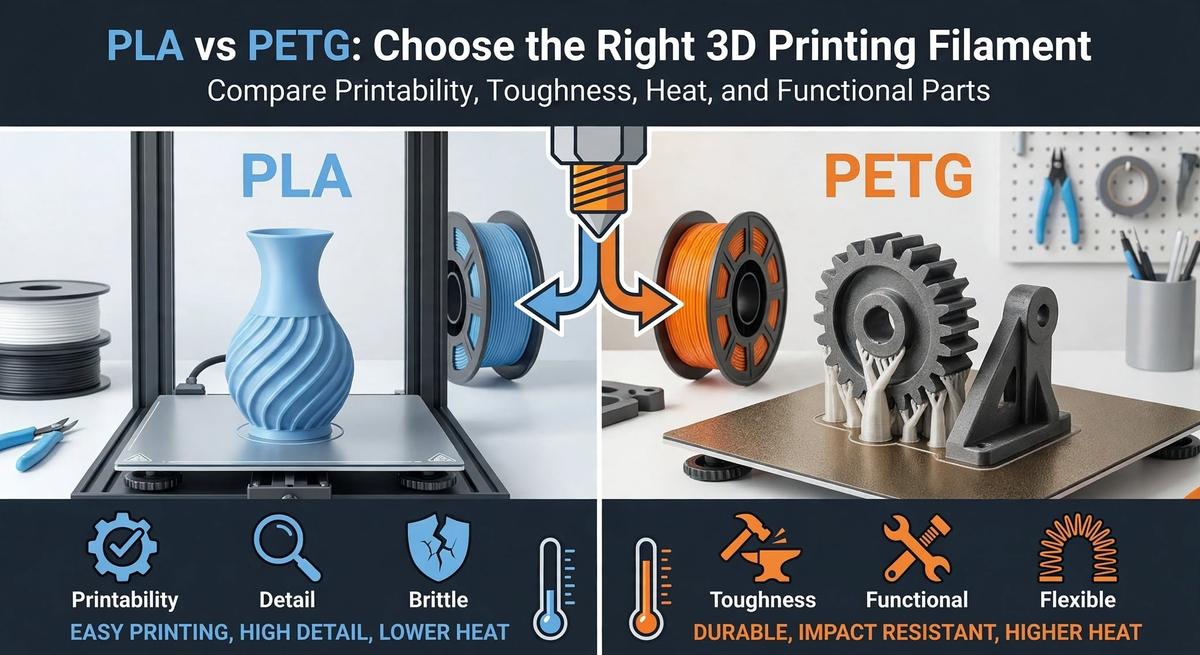
PLA and PETG are two common choices for FDM 3D printing. PLA is often the straightforward option for detailed models and early prototypes. PETG is often considered for functional parts that benefit from more ductility and heat tolerance. Neither material is best for every job.
The useful question is not simply “Which filament is stronger?” It is whether the printed part will fit, carry its intended load, handle the surrounding temperature and meet the required finish. This guide explains the trade-offs and how to make a practical choice.
PLA vs PETG at a glance
ConsiderationPLAPETGPrinting experienceGenerally easy to print and a common choice for beginners.Can need more tuning; stringing and oozing may take extra attention.Typical useDetailed models, display parts and prototypes in mild conditions.Functional parts where extra ductility or heat tolerance is useful.Behaviour under impactStandard PLA can be more brittle than PETG.Generally more ductile, but performance depends on the specific filament and print.Heat exposureCan soften and deform above about 60°C, depending on the formulation and conditions.Often offers more thermal headroom than standard PLA, but is not suitable for every hot environment.Surface and detailOften a convenient choice for crisp-looking models and prototypes.Can produce a good finish, though stringing may need cleanup or tuning.
This is a general comparison, not a guarantee of how a particular spool or printed part will perform. Check the filament maker’s datasheet and recommended slicer profile when material properties matter.
What changes in printability, toughness and heat resistance?
Printability and finish
PLA is usually the easier starting point. It commonly prints with fewer tuning demands, which makes it useful when you are learning a printer or producing a detailed shape. It is also a practical choice when appearance and a quick iteration matter more than impact resistance or heat exposure.
PETG can string or ooze more readily. That may leave fine strands between features or extra material around travel moves. Retraction, temperature and other slicer settings can affect the result, but there is no single setting that suits every printer and PETG formulation. Begin with the filament maker’s profile, then change one setting at a time.
Bed setup also matters. PETG often uses a heated bed and may need different build-surface handling from PLA. Follow the guidance for both the filament and your build sheet; removing a print incorrectly can damage some surfaces.
Toughness is not the same as strength
It is misleading to say that PETG is always stronger than PLA. “Strength” can refer to different things: resistance to bending, impact, stretching or breaking under a particular load. PETG is generally more ductile and less brittle than standard PLA, which can make it a useful choice for parts that need to flex or tolerate knocks. But the exact result depends on the filament formulation and how the part is designed and printed.
Geometry, wall thickness, infill, print settings and layer direction all influence a printed part’s performance. A part loaded across layer bonds may behave differently from one loaded along them. For a bracket or other part that carries a meaningful load, do not treat the filament name as a substitute for testing the actual design.
Heat resistance depends on the part’s conditions
PLA can soften and deform above about 60°C. Treat that as a practical warning rather than a precise limit for every PLA product or every printed shape. Load, exposure time, geometry and the specific filament all matter.
PETG may provide more thermal headroom than standard PLA, but that does not make it a safe default for any hot location. Assess the part’s actual operating temperature and load. A component inside a sun-heated vehicle, for example, can face conditions that differ from the surrounding air. If failure could cause damage or injury, choose using product-specific data and suitable validation, not a general material comparison.
When PLA is the better choice
Detailed models and display parts: Choose PLA when shape, detail and an accessible printing process are priorities.
Early prototypes: PLA can help you check proportions, assembly and appearance before committing to another material or a more developed design.
Parts used indoors in mild conditions: If the part will not face high heat or repeated impact, PLA may meet the need without the extra tuning PETG can require.
First prints on a new setup: If your main goal is to learn basic slicing and printer behaviour, PLA is often a manageable starting point.
Do not select PLA solely because it prints easily if the finished part will sit near a heat source, carry a sustained load or be exposed to repeated knocks. Printability is only one part of the decision.
When PETG is the better choice
Parts that may flex or take knocks: PETG’s typical ductility can be helpful where a more brittle response is undesirable.
Functional prototypes: Consider PETG when a prototype needs to be handled or tested in a way that a display model does not.
Some warmer environments: PETG may be a better candidate than standard PLA where temperatures are higher, provided the part’s actual conditions are within the specific material’s capabilities.
Enclosures, brackets and fixtures: PETG may suit these parts when its material behaviour fits the job. Design, orientation and validation remain important.
PETG is not automatically the right choice for outdoor parts. Weather, sunlight, temperature cycling and the specific product formulation all affect suitability. Check product data and test the part in its intended environment when those conditions matter.
Printing differences: temperature, bed and stringing
Do not copy temperatures from a different brand or assume every printer needs the same settings. Use the spool’s recommended profile as a starting point. Printer design, nozzle condition, build surface and slicer settings can all affect the result.
Start with the maker’s profile. Use the filament manufacturer’s recommended nozzle and bed settings where available.
Confirm the build surface guidance. PETG can require different bed handling from PLA. Follow the build-sheet instructions as well as the filament guidance.
Look for stringing and poor adhesion. A small test print can reveal whether the profile needs adjustment before you print a large part.
Change settings methodically. Adjust one relevant setting at a time so you can tell what improved or worsened the result.
A clean-looking print is not automatically a reliable functional part. Inspect the layers, fit and any areas that will carry load, and test the part under appropriate conditions.
How to choose for parts used in warm Indian conditions
Consider the location of the part, not just the general climate. A part indoors away from sunlight may face different conditions from one on a terrace, near a window or inside a parked vehicle. Direct sun and the surrounding enclosure can change the temperature the print experiences.
Write down the expected temperature range, how long the part will be exposed, whether it is under load, and what could happen if it deforms. Compare those needs with the exact filament’s datasheet. PETG may be a more suitable candidate than standard PLA for some warmer settings, but neither material should be assumed safe without checking the actual conditions.
If temperature data is unavailable or failure would be consequential, use a small prototype to evaluate fit and behaviour, and consider whether a different material or manufacturing process is needed.
Check fit and performance with a small test print
Before printing a full enclosure, bracket or assembly, test a small feature that represents the critical fit or connection. A compact test can show whether a hole, clip, slot or mating face needs adjustment, while using less material and time than a complete part.
For help planning a fit check, see 3D printing tolerances and clearances. For a functional part, also test the relevant load and environment; a fit coupon alone cannot establish how the finished part will perform.
PLA vs PETG: a practical decision checklist
Choose PLA when easy printing, detail and low-heat use are the main priorities.
Consider PETG when the part may benefit from more ductility or greater heat tolerance than standard PLA typically offers.
Do not use a single strength or temperature figure as a guarantee for every spool or printed design.
Check the material datasheet, slicer profile and build-surface guidance for the specific products you use.
For a critical fit or load-bearing part, print and evaluate a test piece before relying on the full design.
For hot, outdoor, food-contact or watertight applications, assess the additional requirements separately. Neither filament alone guarantees suitability.
In short: PLA is often the practical choice for easy-to-print models and low-heat prototypes. PETG is worth considering when a part needs more ductility or may experience higher temperatures. The right answer depends on the part, the conditions and the specific filament—not a universal winner.
If you need a custom part or prototype, Flux3D can help you assess the design and choose a suitable print approach.
Related: 3D Printing Tolerances and Clearances: Validate Fit with Small Test Prints
Flux3D Team
Build it with Flux3D
Need a custom part or prototype?
Flux3D can help turn your design into a practical 3D-printed part.
Get an instant quote